Community Association Law - Condominiums
hoa

• Representing Condo Associations and Property Management Companies
• Developers, financial institutions & individuals
• Governing documents, collections, statutory and regulatory compliance
• Condo Association Attorneys dedicated to the development of community association law

Sachs Sax Caplan's Condominium Association Attorneys in the Community Association practice group have extensive experience in condominium and community association law and, as pioneers, have long been credited with bringing about landmark changes in this area of the law.

Our Clients

Representing condominium associations, financial institutions and individuals with respect to the vast array of difficult issues faced in the creation of and governance of these organizations, members of this practice group specialize in the preparation of, amendment, revision, elections, turnover, and enforcement of governing documents, collections, statutory and regulatory compliance, board meeting conduct and procedure, as well as the many varied aspects of interpersonal relations and corporate conflicts that develop in residential communities. These attorneys have led the way in creating and structuring mandatory country club membership provisions for owners in established communities with amenity packages.

Condo Association Attorneys in Boca Raton & Serving Community Associations Statewide

Our Condominium and Community Association attorneys have the ability to respond quickly and economically to the numerous ongoing issues that arise during the operation of community associations, including turnover of control from the developer to owners, construction defects, accounting irregularities, misrepresentations, termination of developer imposed contracts, recreation lease litigation and buyouts, recreational districts, condemnation, governmental relations, covenant enforcement and reserve irregularities, with creative solutions backed by solid experience.

Depth of Experience & Groundbreaking Decisions

Interacting with the Commercial Litigation & Appeals Group, this experience includes representation of clients in groundbreaking cases such as Ainslie v. Levy, et. al., where members of this practice group successfully argued that documents unit owners were forced to sign as a condition to closing could not supersede the rights granted to the condominium owners under Florida law. The Firm is also credited with establishing the right of unit owners to cancel a perpetual management reservation of control by the developer over recreational facilities at Century Village, Boca Raton. Preserving a historical tradition of expertise in this area of the law, attorneys in the Community Associations practice group continue to make enormous contributions to the development of community association law in Florida.

Florida Statutes Chapter 718 & Administrative Code Chapters 61B-75 through 79

Florida Condo Law relates to the operation, development, and resolution of issues for Condominiums and their owners. Condominiums are creatures of statute. In Florida, Chapter 718 of the Florida Statutes as well as the Florida Administrative Code Chapters 61B-75 through 79 provide the framework for all Florida Condominiums. Membership in a condominium association is mandatory for all owners within a condominium.

Florida Statutes Section 718.103 defines a condominium association as “any entity responsible for the operation of common elements owned in undivided shares by unit owners, any entity which operates or maintains other real property in which unit owners have use rights, where membership in the entity is composed exclusively of unit owners or their elected or appointed representatives and is a required condition of unit ownership.”

The laws that oversee condominium associations are constantly developing and changing with the times, with amendments being made to the relevant laws every year. Our condo association attorneys can provide you, your association, or management company with a yearly legal update where CEU credit is available.

Unresolved disputes or financial problems can directly impact the enjoyment everyone reaps from property ownership, it is important to work with competent counsel who thoroughly understands Florida law surrounding condo associations and is committed to a prompt response that finds an effective solution.

At Sachs Sax Caplan, our lawyers provide skilled representation for both associations and unit owners.

Below is a sample of matters where Sachs Sax Caplan has provided successful representation for its clients:

  • Governing Document Amendment, Revisions and Interpretation
  • Declaration, Covenant and Rule Enforcement
  • Selective Rule Enforcement
  • Late Fees and Regular Assessments
  • Special Assessments
  • Collection of Delinquent Assessments
  • Lien preparation
  • Lien Foreclosures
  • General Civil Litigation, Arbitration and Mediation
  • Insurance Coverage Issues
  • Condominium Foreclosure
  • Preparation and Review of Purchase Contracts
  • Construction Contracts
  • Construction Liens
  • Developer/Turnover Issues
  • Election Abuse/Annual Meeting Assistance
  • Purchase and Sale of Condo Units
  • Terminating Contracts
  • Disputes with the Association/Other Residents
  • Damage Caused by Residents and/or Guests
  • Theft
  • Damage to Vehicles
  • Parking Issues
  • Pet Issues
  • Noise Issues
  • Discrimination

Current Events
04 February 2026
Blogs
By Peter S. Sachs, Esq. While Florida has had few reported incidents of federal officers visiting homeowners or condominium communities, several homeo...
29 January 2026
Blogs
By Greg McAloon, Esq.Sachs Sax Caplan, P.L. Homeowners’ associations (HOAs) and condominium boards are already under increasing financial pressure. Be...
05 December 2025
Blogs
By Michael S. Weiner, Partner at Sachs Sax Caplan Florida’s condominium market is undergoing a seismic shift. As the financial realities of post-Surfs...

5 Things to Keep in Mind When Looking for an Attorney

Angela Prudenti

Hiring an attorney isn’t really something that most people think about, until they suddenly need one. That means the majority people don’t really know what to look for when they do have to find an experienced attorney in South Florida. If you find yourself searching for one of the best lawyers in West Palm Beach and beyond, here are 5 things you may want to keep in mind: 1) One of the first questions you may have is where to find a great attorney in South Florida. With all the TV ads, billboards and website banners, it can seem overwhelming know where to start and whom to trust. That’s why I suggest to start by asking your friends, family, and colleagues. See if they know or can refer you to someone they have had a positive interaction with. Now you may think, “But I don’t want them to know my personal business.” We understand. Maybe you’ve met an attorney and have their business card tucked away somewhere. Dust off that business card and give them a call. If they can't help you, ask them to refer you to someone who can. 2) The next thing you may be wondering is if your needs will be better served by a big firm or a small firm. Here at Sachs Sax Caplan, we have over 30 attorneys and 32 support staff, offering you all the resources of a big firm while also being able to give you and your case the personal attention that comes with a boutique firm, which we consider as the best kind of firm to solve all legal of your needs. 3) Now that you’ve found some attorneys with whom you are interested in meeting, the next step is to schedule a time to determine who is the right fit for you and your needs. Think of this meeting as somewhat of an interview and, as you would for any interview, do your due diligence beforehand. Check out their websites and read about their firms’ previous cases to help you get a sense of who they are and how...

Continue reading

Recent Advancements in Association Law

Michael Chapnick

Warren Buffett once said, “Risk comes from not knowing what you’re doing.” As we approach the end of 2022, we thought it appropriate to see if we can reduce the risk surrounding the management and operation of condominium and homeowners’ associations by focusing on five (5) relatively recent advances in Association Law that may have a profound effect on how these communities operate.  These five (5) areas are: assessment collection letters, association registration, alternative dispute resolution, fining and/or suspension of use rights, and, last, but certainly not least, reserves. As to collections, Sections 718.121(5) and 720.3085(3)(d), Fla. Stat., now require that condominium and homeowners’ associations may not require the payment of attorneys’ fees related to a past due assessment unless the association (or its managing agent) provides the unit owner with a notice letter giving the owner thirty (30) days within which to make payment.  A rebuttable presumption that this letter has been sent is created by the execution of an affidavit by an officer, director, agent, or licensed community association manager attesting to the same.  Thus, if your association plans on attempting to recover its attorneys’ fees from a unit owner for collection of past due assessments, the thirty (30) day letter and affidavit are a necessity. As part of Senate Bill 4-D, all condominium and cooperative associations with buildings three (3) stories or higher are required to report certain information to the Division of Florida Condominiums, Timeshares, and Mobile Homes, on or before January 1, 2023.  The information that is required includes, among other things: the name of the association, the number of buildings that are three (3) stories or higher in height, and the total number of units in those buildings.  Condominium and cooperative associations may register at http://www.myfloridalicense.com/DBPR/condos-timeshares-mobile-homes/building-report/. Since 1992, when a disagreement arose between a condominium association and a unit owner as to an issue that met the statutory definition of “dispute,” they were required to submit to what is called mandatory non-binding arbitration with the Florida Department of Business and Professional Regulation.  Disagreements between associations and owners in homeowners’ associations, on the other hand, had...

Continue reading

Is Virtual Participation in Community Association Meetings Here to Stay?

Michael Ungerbuehler

As Community Association attorneys, something we've been asked often lately is whether associations may hold their meetings strictly by Zoom or any other video conferencing or virtual process. The answer is Florida law does allow videoconferencing and provides the ability to do so for both members and board meetings.  For board meetings, the statute provides that directors may participate in any meeting virtually or by remote communication, including voting on board matters, and that remote communication is deemed to be “in person” participation.  Therefore, board meetings can be held in person, completely virtual, or a hybrid of both. Importantly, the statute requires that the directors attending remotely must be able to be heard by everyone else attending the meeting. For virtual meetings, this is easily accomplished as all participating in the videoconferencing can hear each other when they speak. For in-person meetings, it is necessary for a two-way speaker to be utilized so that any directors participating remotely can be heard by all in attendance.  As to members meetings, Florida law also provides that members may participate remotely. In this respect, the statute requires the board to adopt guidelines and procedures to verify that each person deemed present and authorized to vote remotely, is a member or proxy holder. Once those procedures and guidelines are established, members may participate in meetings remotely, are deemed to be present “in person” at the meeting and may vote remotely. Once the procedures and guidelines are adopted, members may participate in a meeting through Zoom or other videoconferencing methods either on their laptops, or by phone. The key is to be able to identify that the people participating are actually members or their authorized representatives (proxies) who can participate on behalf of the members. This is critical because it ensures that quorum requirements are complied with at virtual meetings.  When preparing the notice for a meeting, it is recommended that the notice specifies in advance whether the meeting is going to be strictly virtual or if it's going to be a hybrid, where some members are there in person and some are virtually attending. Then...

Continue reading

Tips for Returning to Your South Florida Home

Daniel A. Weber

We at Sachs Sax Caplan want to welcome back all of the out-of-town residents who are now coming back down to South Florida after a summer respite elsewhere in the country. As Community Association attorneys, we would like to give you some brief pointers of things we recommend you do upon returning to the Tri County area.  Start by checking your utilities to ensure they are all turned back on. Check for leaks by flushing all toilets and examining all doors and windows in your home. If you do detect any water leakage in those areas, communicate the problem to your association board and your property manager as soon as possible so they can be remediated expeditiously.  Hopefully you won’t find any problems, however, whether you do or do not have any situation to report, you should contact your property manager or board of directors to inquire about what the board has done since the last time you've left. If you've not had electronic communication with them, you're going to want to ask specifically if there have been any special assessments passed or if there any special assessments planned. Determine whether there have been any large maintenance projects completed or in progress or if there are any plans for upcoming work. Projects like this may affect day-to-day operations in the community, and, of course, you will also want to know how any work done will impact the pocketbook that you have with your association.  You should also be aware of the recent legislation passed in the state in response to the Surfside tragedy that involves stricter building safety requirements. One aspect of SB 4-D involves the funding of reserves for the continued maintenance and repair of condominium and co-op buildings three stories or larger that is now required to be in the budget.  Historically, it is unlikely that your association has already prepared or adequately funded their reserves, and these large-scale projects are likely going to result in a special assessment. The sooner your association can plan and prepare, the less of an impact it will have on each owner.  In...

Continue reading

Why is the assistance of an attorney important in the review of service contracts?

Berwin Victor

Benjamin Franklin famously said back in 1736 that “an ounce of prevention is worth a pound of cure.” Mr. Franklin’s saying was most certainly not meant to apply to Florida property owners associations as Florida was not even a state at the time but his advice can be seen as applicable to community associations insofar as service contracts are concerned because it is easier to prevent large costs and legal exposure to an association by sound contract language crafted or approved by an attorney at the start of a relationship with a vendor than to repair the damage that a poorly worded agreement that was simply signed on an association’s behalf without legal review has created. What do I mean by service contract? An important function of an association is to oversee essential services that vendors provide for the community such as landscaping, pest control, asphalt paving, and security. These services require written contracts which should include important terms that protect the association, particularly in the event that the vendor does not perform its side of the bargain or causes damage to a person or property. Why is the assistance of an attorney important in the review of service contracts? Perhaps most significantly, contract disputes can be expensive and time-consuming. And, such disputes are not always incorporated into the association’s annual budget which could put a lot of financial strain on the association and lead to unpopular special assessments. Also, the association can be stuck with a vendor that is doing a poor job. Some examples of where an attorney’s advice is important include making sure the vendor is contractually obligated to provide sufficient insurance and that there are well worded indemnification provisions. There are some nuances in Florida law regarding indemnity and all too often it seems that contracts created by vendors are one-sided and do not protect the association in the event for example that a third party is injured as a result of the vendor’s services. Also, contracts created by the vendor may be unclear or unfavorable to the association regarding the vendor’s responsibilities, the timeframe by which...

Continue reading

New Attorneys Added to the Firm

PB_Post_-_Sachs_POTM_9.26.22.png

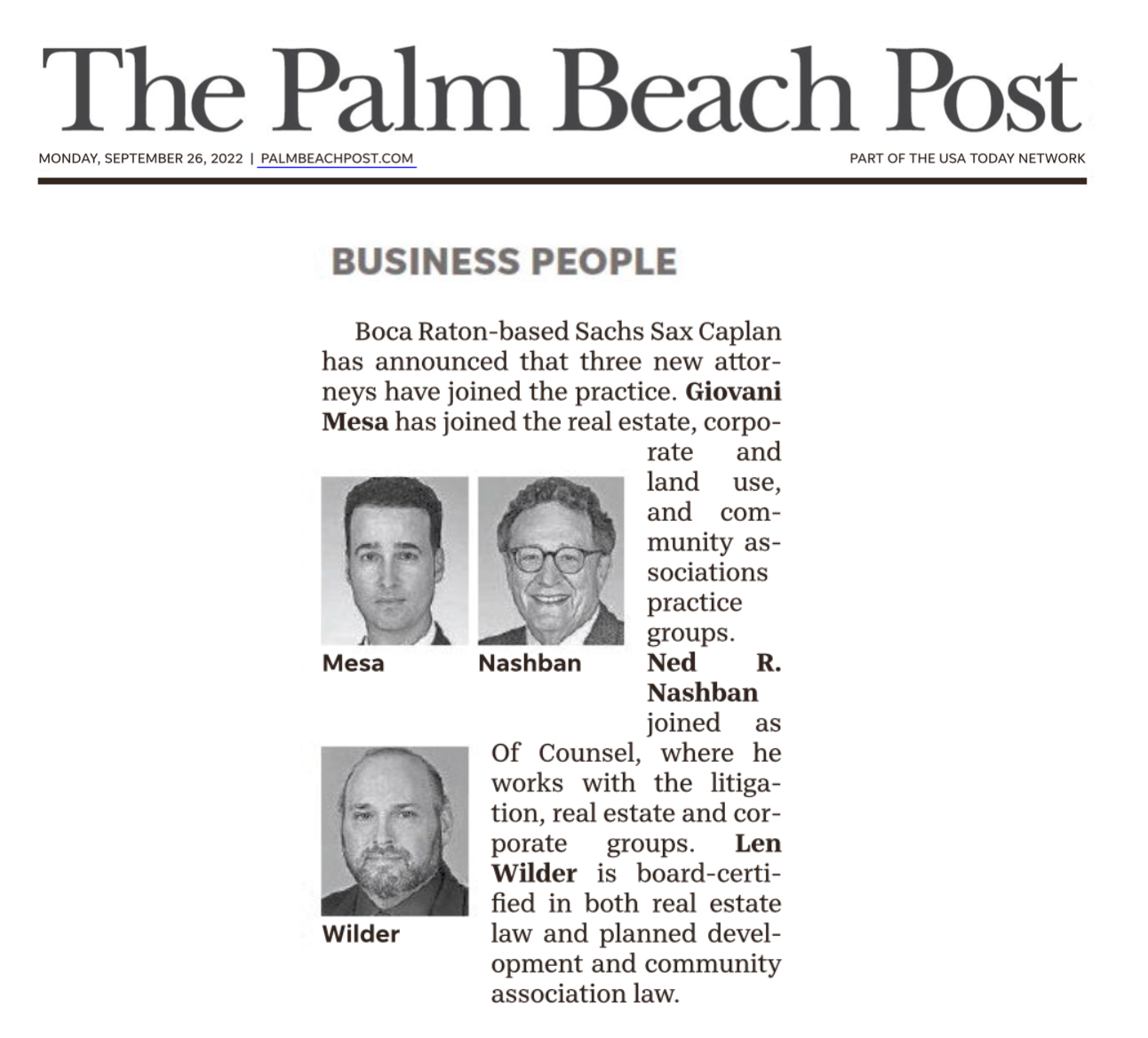
Meet the three new attorneys who recently joined the firm as well as the rest of our experienced  team https://ssclawfirm.com/experienced-attorneys

Tags:

South Florida Attorneys Peter and Maria Sachs Travel to Italy, to Speak to Law Students at Univ. of Naples Federico II

peter-sachs-maria-sachs-amede.jpeg

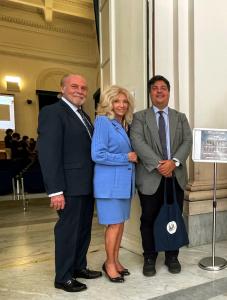
BOCA RATON , FL, USA, September 19, 2022 https://www.einpresswire.com/article/591672087/south-florida-attorneys-peter-and-maria-sachs-travel-to-italy-to-speak-to-law-students-at-univ-of-naples-federico-ii-- Peter Sachs, Board Certified Attorney and Founding Partner of Sachs Sax Caplan, P.L., a Boca Raton based law firm, and Maria Sachs, Palm Beach County Commissioner, Former Florida State Senator, and Criminal Defense Attorney, were hosted by the American Studies Center of Naples earlier this month in Naples, Italy, where they jointly spoke with Law Students at the University of Naples Federico II in Naples, Italy. Established in 1224, the University of Naples Federico II is the oldest public nonsectarian university in the world, and among the largest three in Italy in terms of faculty.The Sachs’ presented on a range of topics including the role of law and lawyers in the United States; a historical perspective connecting Italian to United States law; Florida condo law (its origins being tied to ancient Roman law); criminal law and the influence of media; and the business of running a law firm. Both Peter and Maria Sachs also shared their personal journeys. Peter speaking on his background as a first-generation immigrant with origins in a refugee camp just after the Holocaust and his beginnings as an attorney, and Maria, with Neapolitan origins, beginning her career in the service of Janet Reno, who later became the first woman to hold the position of U.S. Attorney General.“It was an honor to have the opportunity to address an audience of young aspiring Italian lawyers and speak about my personal experience leading Sachs Sax Caplan, a firm I founded five decades ago, as well as being a pioneer in Condominium and Community Association Law in Florida,” said Peter Sachs. “Maria and I are committed to future collaborative efforts with the faculty and the students here at the University of Naples Federico II.”Maria Sachs added: “I have always thought that my Neapolitan origins have constituted an advantage in my forensic and political career. This meeting with the students at University of Naples Federico II confirmed it. In the eyes of the students, as well as in their questions and observations, I found that same intelligence and curiosity that is typical of Neapolitan...

Continue reading
Tags:

New Mandatory Reserve Requirements for Condominiums and Cooperative Associations

brian_meanley_1619113230.png

More than a year after the tragic collapse of the Champlain Towers South condominium building in Surfside, Florida, condominium and cooperative associations throughout Florida now face a host of new legal requirements and restrictions imposed by SB 4D, which was passed unanimously by the Florida Legislature and signed into law by Governor DeSantis on May 26, 2022. The legislation is aimed at protecting the long-term structural safety and integrity of multi-story buildings in Florida and preventing similar tragedies. In previous columns, SSC has discussed the inspection and transparency requirements of the new law. However, although such legislation may be long overdue and well-intentioned, unit owners in condominium and cooperative associations throughout Florida are likely to find that in the short term the cost of living in such buildings will increase significantly, as a result of the requirement that associations collect mandatory reserves on an ongoing basis. In addition to requiring “milestone inspections” and imposing new reporting and transparency standards on matters relating to building structural safety and integrity, SB 4D creates strict new requirements for associations three (3) stories or taller regarding the calculation and funding of reserves for long-term maintenance and replacement of certain “structural” components of these buildings. Specifically, at least once every ten (10) years, associations must now complete a so-called Structural Integrity Reserve Study (“SIRS”) for each building in the condominium or cooperative that is three stories or taller. A SIRS is defined as “a study of reserve funds required for future major repairs and replacement of the common areas based upon a visual inspection of the common areas." Although the reserve study may be performed “by any person qualified to perform such study,” such as an accountant, the visual inspection portion of the SIRS must be performed by a licensed engineer or architect. At a minimum, the SIRS must identify and state the remaining useful life and replacement cost or deferred maintenance expense of the common areas being visually inspected and, based upon such visual inspection, provide a recommended annual reserve amount that should be included in the association’s annual budget for those common areas. Several...

Continue reading

Part 2- August Series- INSPECTIONS - TRANSPARENCY

Len Wilder

Born from the tragedy of Surfside’s Champlain Towers South collapse is the passage of Senate Bill 4D that was signed into law by Governor DeSantis on May 26, 2022. For the first time, state law now mandates that condominium and cooperative buildings that are three (3) stories or higher must undergo milestone structural integrity inspections, must obtain structural repair reserve studies or reports and in accordance with such inspections and reports, must collect adequate reserves to fund anticipated structural repairs to the association’s roof, load-bearing walls, floor, foundation, and other structural components enumerated in the new statute. Further, effective December 31, 2024, associations will no longer be able to waive these reserves or use the funds for different purposes. The necessity for these mandatory requirements was readily apparent as many condominium and cooperative communities delayed or otherwise put off making essential repairs due to financial concerns. Such delays, as recently demonstrated, may lead to tragic consequences. Now, the failure to fund reserves can be deemed a breach of fiduciary duty of the board of directors and officers of the condominium or cooperative association. A significant part of the new law also requires a level of transparency that has not existed beforehand. The Condominium (Chapter 718) and Cooperative (Chapter 719) Acts have always required their official records to be open for inspection by any owner or their representative. However, the recent amendments now stress a heightened level of importance in ensuring that structural inspection reports and reserve studies are publicized as follows: (1) condominium and cooperative associations must now distribute a copy of its required inspection report to all owners by either U.S. Mail, hand-delivery or if authorized beforehand by a unit owner, via email; (2) the inspection report must be posted in a conspicuous place on the common areas as well as published on the association’s website if such website is statutorily required; (3) both the inspection report and the structural reserve study must be kept with the official records of the association for at least fifteen (15) years; (4) a copy of the inspection report must be furnished to local...

Continue reading

Closing on Your Home: Why You Need a Real Estate Attorney

Closing on your home?
Daniel A. Kaskel

My firm receives roughly three phone calls a month from people that have bought or sold homes without the help of a professional real estate attorney and experience post-closing issues. As real estate lawyers, we're here to help avoid having to make those phone calls in the first place.  In the State of Florida, it's not required to have an attorney for your closing transactions – but it is highly recommended. Buying a home is a significant investment, and similarly selling a home is a significant transaction.  Whether buying or selling, you need an attorney on your side, representing your best interests. A real estate agent plays a very important role, but they're not attorneys, nor do they render legal advice. Similarly, in Florida, a title agency serves a role, but they're an independent third party. They do not “represent” you.  However, a board certified real estate attorney can represent you and look out for your best interests. So, why exactly do you need an attorney on a real estate transaction? Following are important issues that an experienced real estate attorney will assist with: Taking Title - An attorney will help you avoid post-closing issues by clarifying important issues at the outset.  Firstly, how do you want to take the title – individually? Jointly? Perhaps you are better suited with a life estate, trust or other type of planning mechanism.  It is far better and more cost-effective to address these issues prior to closing. Tax Planning - Tax planning, including transfer taxes at closing, real estate taxes and potential income taxes, are issues that can be addressed and planned before closing takes place if you discuss it with an experienced real estate attorney beforehand.  Surveys - An attorney will help you raise and review important survey and title issues that a title agent may not share with you – or may not know to. In fact, some title agents close without a survey. However, we always recommend closing with a survey reviewed and commented on by an attorney.  Title Objections - Your attorney will also raise title objections that a title...

Continue reading

Understanding the Mechanics of Your Commercial Lease

Daniel A. Kaskel

Rent is typically a business's second largest expense following wages and a lease is often a five to ten year term. Therefore, your lease is probably one of the most significant contracts that you as a business owner will enter into. And it's probably one of the most costly ones, too. That’s why it's important to understand some of the mechanics of your commercial lease.  Commercial leases are often negotiated, and a reasonable landlord will consider modifications that benefit the tenant.  As a Florida Bar Board Certified Real Estate Attorney, with significant experience in commercial leasing, following are some considerations that I recommend people think about before signing a lease: Exit Strategy: What is your exit strategy? Can you terminate the lease early? And if so, under what circumstances?  Can you assign or sublease? The permitted use allowed in the lease is a function of what you can or can't do with respect to your exit strategy. Timing: What is the timing of the landlord or tenant construction/improvements? Responsibility: Who's paying for construction/improvements? How and when is the landlord dispersing any tenant improvement allowance? Code Changes: Who is responsible for required improvements to the property due to code changes? For instance, several years ago, the ADA changed, and every commercial space had to be modified, therefore you need to know who's responsible for paying and making those changes? CAM Expenses: How are operating expenses, often referred to as CAM (common area maintenance), determined? What's included and excluded in the component of CAM? What are your audit rights as a tenant to review and audit the way the landlord has assessed CAM?Future Alterations: What are your rights to make alterations and improvements to the property after the lease commences? This is particularly important for leases with longer terms and renewal options. Parking: An issue that I find a lot of tenants asked me about is parking and signage. To what extent do you have reserved parking and does any other tenant in the building have reserved parking? Signage: What are your signage rights and who's paying for your signage? Personal Guaranty: Is the lease personally guaranteed, and if so,...

Continue reading

New Building Inspection Requirements

Berwin_Victor.jpeg

The proverb “time and tide wait for no man” may be true, particularly regarding the impact of the sunny, salty, and windy conditions on structures along Florida’s coasts.  However, a recent law requiring periodic inspections of buildings will help protect community associations and the millions of people who live in condominium units from the harsh reality revealed by that expression.  These new safety measures may impact associations’ finances but careful planning ahead should mitigate against any severe impact on condominium unit owners.  Recently, and almost a year after the catastrophic collapse of Champlain Towers South in Surfside, Governor DeSantis signed into law requirements, unanimously approved by both chambers of the legislature for periodic inspections based on the age and location of buildings and for association condominium boards to set aside sufficient reserve money to cover future repairs.  Though the law took effect on May 26th, condominium buildings within the “milestone” age requirements have until December 31, 2024, to comply with the inspection requirements.  The milestone requirements apply to condominium buildings three (3) stories or higher and require that the following be re-certified as safe: (i) all buildings thirty years old or older; and (ii) those buildings at least twenty-five years old and within three (3) miles of the coast.  Every ten (10) years after that, all buildings to which the statewide structural inspection program applies must be re-certified again.  Generally, initial milestone structural inspections must be conducted by December 31st of the building’s 30th or 25th year based on the date the certificate of occupancy for the building was issued and depending upon its location in relation to the coast.  The new laws will not apply to most Chapter 720 Homeowners Associations provided that none of the structures within the community are three (3) stories or higher. There are two (2) phases for mandatory inspections.  If a visual inspection by a licensed engineer or architect reveals no signs of substantial structural deterioration, no further action is necessary until the next required inspection.  However, if structural deterioration is detected, a second phase of more thorough testing is required.  Such inspections may potentially...

Continue reading

Steve Geller Serves as Panelist at National Gaming Law Conference to Discuss Sports Betting

Geller Steven

The National Council of Legislators from Gaming States (NCLGS) held its Summer Meeting at the Westin Copley Place in Boston, Massachusetts in early July 2022. Steven Geller, who is the NCLGS’s General Counsel, was a panelist on the topic of Sports Betting at the conference. The conversation centered around the Wire Act of 1961, which banned gambling across state lines. Prior to 2011, the U.S. Department of Justice stated that the Wire Act applied to all types of gambling.   In 2011, the U.S. Department of Justice reversed their prior opinion, and stated that the Wire Act only applied to sports betting. In 2018, the same body reversed the reversal, and again declared that the Wire Act applied to any form of gambling. In 2020, a federal judge ruled that the more limited 2011 interpretation was correct.  In 2021 The 1st Circuit Court of Appeals agreed with the Federal Judge’s ruling that the Wire Act only applied to Sports betting.  However, the U.S. Department of Justice has not changed their interpretation that the Wire Act applies to all types of gambling. These confusing rulings and reversals of the Act were debated by the panel during the session, and, most importantly, how the Wire Act applies to Sports Betting. “In my belief, the current state of sports betting is based more on what people want the law to be, instead of what the law actually is,” said Geller.  “I believe all of these attempts at wireless sports betting seem to violate the Wire Act,” Geller said. “I think [sports betting] should be limited to in-person. Now, do I think Congress should change the law? Absolutely. But until they do, I think we are bound by [the Wire Act].”  Geller said that consideration of limiting sports betting to brick-and-mortar sites might best be looked at for lawmakers in the sense of job creation — with online gambling employing far fewer local residents. “That is one of the fundamental reasons that people justify [legalization of] gambling,” Geller said. When the conversation turned to the possibility of a group of states forming a collective in an...

Continue reading

Partner Larry Schner Featured in Sun Sentinel Discussing Residents’ Concerns Over New Boca Raton Chick-fil-A

A new location of Chick-fil-A at 2700 N. Federal Highway in Boca Raton has nearby residents concerned that the proposed drive-thru restaurant will cause traffic and safety problems along Federal Highway. The Chick-fil-A would replace the existing Best Western hotel, which would be demolished with three one-story buildings taking its place. Chick-fil-A would be located on the south end of the property and adjacent to the Harbor East residential community. Sachs Sax Caplan Partner Larry Schner, who represents the Harbor East residents, cited problems at other Chick-fil-A locations: “It’s a situation which they can’t enforce in Broward County. It’s a situation which they can’t enforce in Delray. It’s a situation that spills into the community and spills into Federal Highway. The building of a Chick-fil-A in this area is not responsible.” Despite the concerns, the planning and zoning board unanimously approved the project. The final decision, however, will rest with the City Council, which will vote on the matter later this year. Read the full article here.    

Why Everyone Should Have an Estate Plan

There are many common misconceptions regarding estate planning. People sometimes assume they only need a plan if they're wealthy or that everything will automatically go to their children or spouse. As experienced estate planning attorneys, we recommend that everyone – regardless of age, wealth, and family status – have an estate plan.  Some estate plans are simple and require only a couple of documents, while other plans are more complex. The plan that is right for you should be determined by an experienced estate planning attorney and would be formulated during your consultation process. Oftentimes, there are multiple ways to achieve the results you desire. The main goals of estate planning include: Designating people to make your medical and financial decisions for you while you are alive;Ensuring your property passes to the people you want in the percentages you want, and;Avoiding probate. Clients with minor children are also concerned with designating someone to care for their children should something happen to them. While the Florida law and statutes provide for default answers to all of these situations, having estate planning documents in place can ensure that those responsible for making decisions on your behalf have an easier time doing so. Further, depending on your life’s circumstances, you may not want the default people acting for you or inheriting from you in the way the law outlines. Having a plan really keeps you in control. It allows you to dictate and influence how your own wellbeing is cared for as well as how your family is taken care of after you pass. Schedule a complimentary consultation to learn more about the options and planning tools that are right for you.  

TFB


Sachs Sax Caplan, P.L. is proud to be recognized by The Florida Bar for our commitment to hiring and developing Board Certified Attorneys.